Life on Mission Workshop

Join us for a half-day training designed to transform your idea of 'evangelism' and equip you to share Jesus with lost people you already know and love—in a natural, relational way. Afterward, we’ll walk alongside you, providing the support and accountability you need as you live out your calling.
Frequently Asked Questions
When is the next Life on Mission Workshop?
TBD
How much does it cost?
It’s free, even your lunch (if you register). Search is supported entirely by local donors who believe you’re worth investing in! But please register (it helps with set up, materials we provide, and how much food we should prepare).
What's the catch?
Well, this is an investment of your time. We’re all busy people, and we can’t say yes to everything. But rest assured, we will do everything in our power to make it worth your while. Second, Jesus’ game plan was to make disciples who make disciples. So we hope this isn't a just five-hour commitment on a Saturday, but a lifetime of living on mission in everyday life.
What are people saying?
“The Workshop implements God’s plan for reaching the world through one-on-one relationships. The training has opened my eyes to how God has been working in my life for decades, waiting for me to actively engage. I am beginning with those He is bringing to me.”“People need to be reminded of these principles, no matter where they are in their walk with Christ. I needed to be reminded that the results are up to God, not me. I’m role is to live out my faith.”“The Workshop was revolutionary in my perspective of how God uses His people in the process of seeking the lost. This training is essential to those new in their faith and those who have followed Jesus for decades. I have been challenged to step out of my comfortable life and join the Holy Spirit in His saving work in the world. And I have been equipped with simple and powerful tools to help me share Jesus with others.”“The Workshop was so much more about our walk with God than 'converting people.' I learned so much about areas of growth in my relationship with God and support on how to focus on those areas. My world was rocked—I have been striving so much and am learning how to abide. That will be my focus!”“The Workshop empowered me! Talking with lost people about Jesus isn’t such a big deal, and I don’t have to be a perfect Christian, just approachable and intentional about loving others and engaging with them about what matters most. Now, I find deeper conversations lead to Jesus organically because I love Him so much.”
Can I just show up?
Um, well, it would be super awesome if you would please register using the button above. We'd like to have food and resources for everyone!
What's the agenda?
Session One: I Can Do That!Jesus said, “Go and make disciples.” Sometimes I wish that I could just rake my neighbor’s leaves and somehow they would realize that Jesus died on the cross for their sins. Yes, acts of kindness could be a part of sharing the Gospel, but at some point sharing the Good News of Jesus means we … talk about Jesus! But talking to people about Jesus sounds like “evangelism,” and if we’re honest, that word has a funky aftertaste in our culture. And for good reason. We as Christians have done a lot of damage and created a lot of weirdness for the rest of us by how we have gone about the task. What if we need to reframe what Jesus really meant by "go and make disciples"?Session Two: Relational EvangelismJesus called his disciples to a mission: to fish for people. The last thing He said was to re-affirm that this was the mission: to go and make disciples. But this is uncommon language for us. What does 'making disciples' even mean? Inviting someone to church? Telling someone they're going to Hell? Passing out tracts?Session Three: Where to StartJesus did not seem to struggle to obey the Father. He lived a perfect life, continually engaged in sharing the Good News of the Kingdom of God. Yet we struggle to share the Good News. What was Jesus' secret for living a fruitful, obedient, world-impacting life?LunchLunch is provided for free by Search KC for those who register. Search KC is funded 100% by donations from people who believe that every person in Greater Kansas City deserves an opportunity to know and share Jesus.Session Four: Living as a Sent PersonMost American Christians think of evangelism as sales. But how does the Bible describe making disciples? What if we expected that God was sending us to someone who needs Him? What if every interaction was, potentially, a divine appointment? What if every encounter was a possible rescue mission on your deployment?Session Five: The Gospel According to JesusWhat was Jesus' mission, according to Jesus? The phrase Kingdom of God/Heaven is used 85 times in the Gospels, but most of us struggle to define it. Perhaps we should clarify the message Jesus asked us to share.Session Six: The Good News ConversationSpirituality is a process and God is responsible for the results. Success is living out your faith, being a witness, and trusting God for the results. Success is not leading someone to Christ. In this last session, we'll give you a free Bible for sharing your faith and teach you how to open it with a seeking friend.
Can my church or organization host the next Workshop?
As you can imagine, the church that hosts the Life on Mission Workshop has the most attendees and therefore sees the most transformation in the lives and hearts of its people! We love seeing congregations come alive and would be delighted to serve you in this way! Please contact us to learn more about hosting a future workshop!
OPEN FORUM CORE TEAM TRAINING
WHO IS THE CORE TEAM?
Core Team members are those who:1. Pray daily for the Open Forum and all the guests.
2. Invite and bring at least one non-Christian friend.
3. Engage in long-term follow-up with their guest.
IS THERE A PEANUT GALLERY?
To be clear, there are only two types of people in the room: Core Team members and the non-Christian guests they brought. Many believers want to come and watch, but not bring a lost friend. The answer is no.To create a space where non-Christians can freely explore God, faith, and life through honest conversation, we do not allow observers.Even if they remain silent, an "audience member" changes the dynamics, making guests less comfortable speaking openly. The goal is to create a space where people feel free to ask questions, express doubts, and explore spiritual things without feeling watched or evaluated.There are two ways to attend an Open Forum:1. Be a Core Team member who has brought a non-Christian friend.2. Be a non-Christian.If you are a believer who is interested in attending an Open Forum but do not have a non-Christian guest to bring, we encourage you to focus on developing friendships with non-Christians. The Reach Series is a great resource for learning how to do this! Then, when you have non-Christian friends, become a Core Team member!
WHAT IS THE OPEN FORUM?
1. The goal is to create a safe place to have a healthy discussion! We are settling for limited objectives! We desire to continue the conversation.2. Please do not give an answer or state your opinion. Rather, identify with the question and the questioner or nod quietly. Even if you give an amazing answer with a good tone, the questioner won’t likely be as affirmed as if you sincerely identified with the question. This will be difficult, but you can do it!3. Heads up: I will not directly answer every question. Even if I took 30 minutes and totally ruined the conversation with my amazing and eloquent speech, I couldn't answer their question completely. We will likely get more than one topic; I will likely only address one, which means some questions will remain unanswered—leaving guests wanting more conversation.4. It's been said that a sign of a good Open Forum discussion is that the Christians didn't enjoy it. This is because sometimes we're oddly surprised when an unbeliever expresses his/her view, and it's different than our own. The goal in culture (particularly online) is to shut people down, but we want them to win! When someone says something you don't agree with, you'll likely get a knot in your stomach. Great Core Team members prepare in advance for the knot!5. What is an Open Table? A small Open Forum around a table, over a meal.
WHEN ARE THE NEXT OPEN FORUMS?
THURSDAY OCTOBER 1
11:30 AM - location communicated directly with trained Core Team membersTHURSDAY OCTOBER 8
11:30 AM - location communicated directly with trained Core Team membersTHURSDAY OCTOBER 15
11:30 AM - location communicated directly with trained Core Team members
PRINCIPLES FOR INVITING NON-CHRISTIANS
1. Identify and list your network of seeking friends and invite only those who don’t seem to have a personal relationship with Christ. Do not invite Christians to the Open Forum!2. Invite non-believers who are responsive to you, or would be open to cultivating a relationship based on common ground (areas of shared interest, background, experience, ability, or life situations that serve as the basis for developing relationships).3. Invite non-believers you don’t think will come, as well as those you think will come.4. Be transparent: describe the Open Forum as a discussion that will examine God and life issues.5. Invite non-believers with whom you have regular contact (take them to a sporting event, have them over for dinner, attend a concert, etc.).6. Be sensitive to the non-believers God may bring across your path (acquaintances, new friends, etc.).7. Be personal: “I thought you might enjoy this discussion. Would you like to come with me?”
YOUR GUESTS MAY ASK...
Something like this is very rare because Christians tend to preach more than they listen. Your non-Christian friends may be legitimately skeptical when you tell them this is a discussion, not a lecture, and not a debate. They may ask:1. Who leads it? The discussion moderator is someone who has studied in this area and who enjoys leading these groups.2. Is this sponsored by a church? No. It is not the goal of the group to get people to join any particular church. There are many different beliefs represented in these groups.3. What is the real purpose of these discussions? The perfect Open Forum is one where everyone is trying to extend their knowledge instead of trying to prove that they are right. We want to help people think through their beliefs. As various viewpoints are presented, biblical Christianity’s perspective will also be discussed.4. Do I have to talk? I don’t know if I can verbalize my beliefs. No. If you come and listen - great! There may be someone else at the discussion who will have similar beliefs. So come and relax! And if you want to throw in your viewpoints, great!5. Is someone going to try to convert me? No one can force anyone to believe anything they don’t want to. Part of the moderator’s job is to make sure no one forces their viewpoint on anyone.6. Is this a religious discussion? Not exclusively, although there will undoubtedly be religious issues discussed. No one religious perspective will be represented exclusively. It is just a group of people trying to think more clearly about their beliefs in a discussion format.7. What if I’m an atheist (agnostic/Muslim/Satanist, etc.)? Cool. It will help to produce a dynamic discussion if the atheistic position is represented.8. Is this just a setup so you can corner me with your Christian position? No, there is no hidden agenda. Our real goal is to have a stimulating discussion on belief systems. Socrates said the unexamined life is not worth living. In a lot of ways, it is also true that the unexamined faith is not worth believing. The Christian perspective will be presented as an alternative for discussion, along with the other viewpoints represented. Of course, I’d like to see you believe what I believe. But our real intent is to evaluate all of our belief systems in light of biblical Christianity. This is not a setup just for Christianity; other viewpoints will be discussed.
POTENTIAL NEXT STEPS MIGHT BE
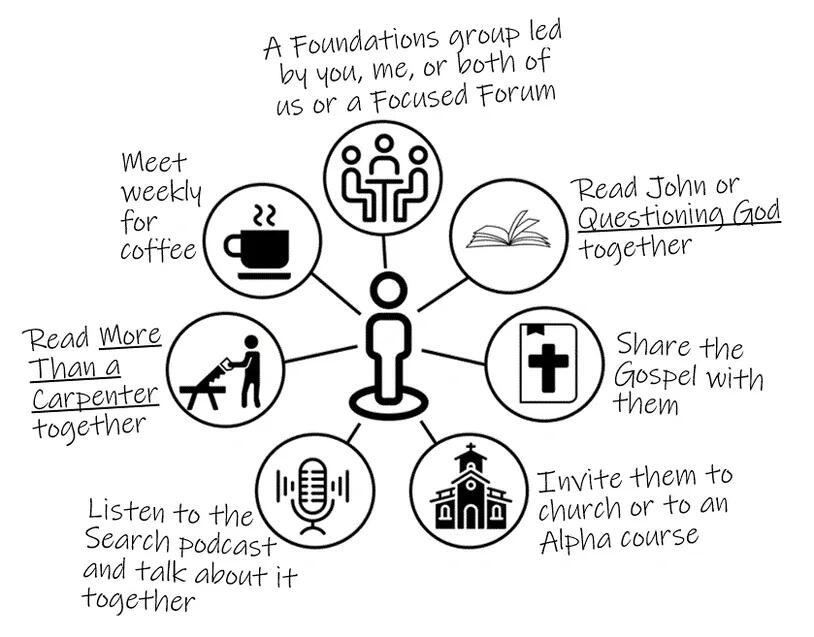
1. A Foundations group led by you, or by me, or both
2. A focused Forum
3. Read Questioning God together (Hopper)
4. “Would you like to read the Bible with me?”
5. Read More Than a Carpenter (McDowell)
6. Listen to the Search Podcast
7. Share the Gospel
8. Begin a regular fire pit chat
9. Listen to their story, share your testimony
10. Gather weekly for food and to talk about the big questions of God and life
11. Do service projects together
12. Take a break from spiritual talk—they’re just not into it right now. Focus on prayer for the softening of their heart.
13. Invite them to church
FOUNDATIONS BOOKS
HOW TO ORDER
Email [email protected] the following information:Full name
Complete shipping address
Phone number
Email address
Titles of the Foundation books you would like to order, along with the quantities for each title (each book is $5.00).Iris will respond with the total cost of the books as well as the shipping charges via FedEx Ground. A payment link will then be sent through Stripe. Your books will be shipped upon confirmation that the payment has been successfully processed.
ORBITING NOTHING
In a quiet Midwestern college town, Dirk Alvarez drives his city bus in endless loops, convinced life is nothing more than random atoms colliding in a meaningless void. But when a UFO crashes in the woods behind his house, Dirk's worldview shatters. Befriending Wibble—an eccentric, four-eyed alien on a research mission—Dirk is thrust into a whirlwind of chaos: barroom philosophies on God and existence, heart-pounding chases from federal agents, and confrontations with his own doubts. Orbiting Nothing is a witty, thought-provoking blend of science fiction and faith, where one man's encounter with the unknown orbits him toward a life beyond what we see, smell, taste, touch, and hear.
Book Club Discussion Guide
Week 1: The Weight of Nothing (Chapters 1–7)
We are introduced to Dirk, an apathetic city bus driver who views life through the lens of random atomic collisions and nihilism ("Biochemical Meat Machines"). We also meet Chase and Loreen at The Rusty Nail, and get a glimpse of Dirk's background and his philosophical skepticism.• Do you identify with Dirk’s cynicism and his motto that ‘nothing really matters’? Could he be right?
• How does the atmosphere of The Rusty Nail and Dirk's interactions with Chase and Loreen set the tone for the novel?
• Loreen uses the painting of dogs playing poker and the concept of an artist to explain cause and effect to Dirk and Chase (pages 17–18). What do you think of her argument that nothing cannot create something? Do you find common-sense cosmological arguments persuasive?
• On page 22, Dirk thinks religion is like picking an ice cream flavor. Why do you think so many people view religion as merely a matter of personal taste or utility rather than objective truth?
• On page 31, Dirk wonders if people invented God to fulfill their need for comfort and a father figure. Have you ever wrestled with this critique of faith? How does the book challenge or address this idea?
Week 2: Ripples and Reality (Chapters 8–14)
Following the death of Lucky, Dirk’s emotional armor cracks. He visits Nana on Easter Sunday, where they consider historical evidence for the resurrection. Later, Dirk encounters a mysterious, humming metallic sphere in the woods behind his house.• How did your perspective on Dirk change as he experienced grief over Lucky and faced the reality of his own mortality?
• If you were in Dirk's shoes and discovered a glowing, otherworldly orb in the woods behind your home, what would your immediate reaction be?
• During Easter dinner (pages 41–46), Nana shares that the resurrection of Jesus is rooted in historical evidence and eyewitness testimony rather than wishful thinking. What do you think of her argument that the disciples wouldn't die for something they knew to be false?
• Dirk struggles with the tension between the fixed laws of nature and the possibility of miracles (page 43). Do you believe miracles? Why or why not?
• On page 42, Dirk wonders if justice even exists if life has no meaning. How does the concept of a Creator change our view of objective right and wrong, and of justice in the world?
Week 3: The Best Eleven Minutes (Chapters 15–21)
Dirk and Wibble discuss dark matter, free will, and the origin of evil. We meet federal agents Jack and Briar. And Dirk asks Emma out but yields to temptation by posting a photo of Wibble online.• What did you think of Wibble’s explanation of Plorp? How has sin marred our world?
• Why do you think Dirk gave in to the temptation to post Wibble’s picture online, despite knowing the risks and his friendship with Wibble? Have you ever compromised your values for approval or attention?
• On Plorp, free will existed, but because they trusted God, they avoided sin, suffering, and death (pages 89–93). What is the relationship between free will, love, and the presence of evil?
• On pages 88–90, Wibble challenges Dirk's notion of faith, explaining that believing the universe, life, and consciousness came from nothing takes an immense amount of faith. How did this shift in perspective impact your view of faith versus rationality?
• On page 61, Emma tells Dirk, “If God did appear in an irresistible and overpowering way, what would be the reason people believed?... God has much more in mind for us than being scared into worshiping Him.” Why do you think God chooses a relationship built on trust and revelation rather than undeniable, coercive proof?
Week 4: The Storm Breaks (Chapters 22–28)
Dirk and Emma enjoy a conversation over dinner at the Atomic Drifter about the uniqueness of Christianity compared to other worldviews and what truth actually means. Then chaos erupts: the viral photo brings intense scrutiny, Otto tracks down Wibble and kidnaps Nana, and Dirk faces the ultimate breaking point.• What stood out to you most about Emma and Dirk's conversation regarding truth, worldviews, and The Da Vinci Code?
• On pages 128–129, Emma distinguishes Christianity from other worldviews by pointing to its grounding in public, verifiable history rather than private myths. Do you believe historical evidence is important when evaluating spiritual truth claims? Why or why not?
• Agent Jack Bell’s deep cynicism and hatred toward God stem from a painful church experience (pages 163–166). How does Briar help distinguish between human hypocrisy and Jesus's true character? Have you ever been hurt by religious hypocrisy? How has it impacted you, emotionally?• In the basement, facing the loss of his Nana and complete helplessness, Dirk finally prays an honest, broken prayer (page 161). What does Dirk’s surrender teach us about how God meets us at our absolute lowest points?
Week 5: New Horizon (Chapters 29–Epilogue)
Following Nana’s passing, Wibble returns to rescue Dirk. Wibble departs for his home planet, leaving Dirk fundamentally transformed. Dirk embraces new life in Christ, finds peace with Emma, and wakes up to some profound, eternal realities.• How did the resolution of the story—balancing the sci-fi elements with Dirk's spiritual awakening—satisfy or surprise you?
• Chase notes at the end that Dirk seems deeply different—"Alive, maybe? Like really alive?” (page 184). How has Dirk’s definition of a successful, meaningful life changed from Chapter 1 to the end of the book?
• Wibble tells Dirk right before leaving: “Make much of the life you have been given. Life to the full is more than an expression; it’s a genuine offer.” (page 183). What does "life to the full" look like for someone who has surrendered control to God?
• Dirk realizes that his barrier to faith wasn’t really intellectual, but emotional (pages 177–178). How can recognizing our own emotional pain, anger, and a desire to be in control open the door to spiritual healing?
• C.S. Lewis’s quote opens the book: "If I find in myself a desire which no experience in this world can satisfy, the most probable explanation is that I was made for another world." Looking back at the entire journey of Orbiting Nothing, how does this quote capture the overarching message of Dirk's transformation and spiritual awakening?